Getting Pregnant (on purpose)
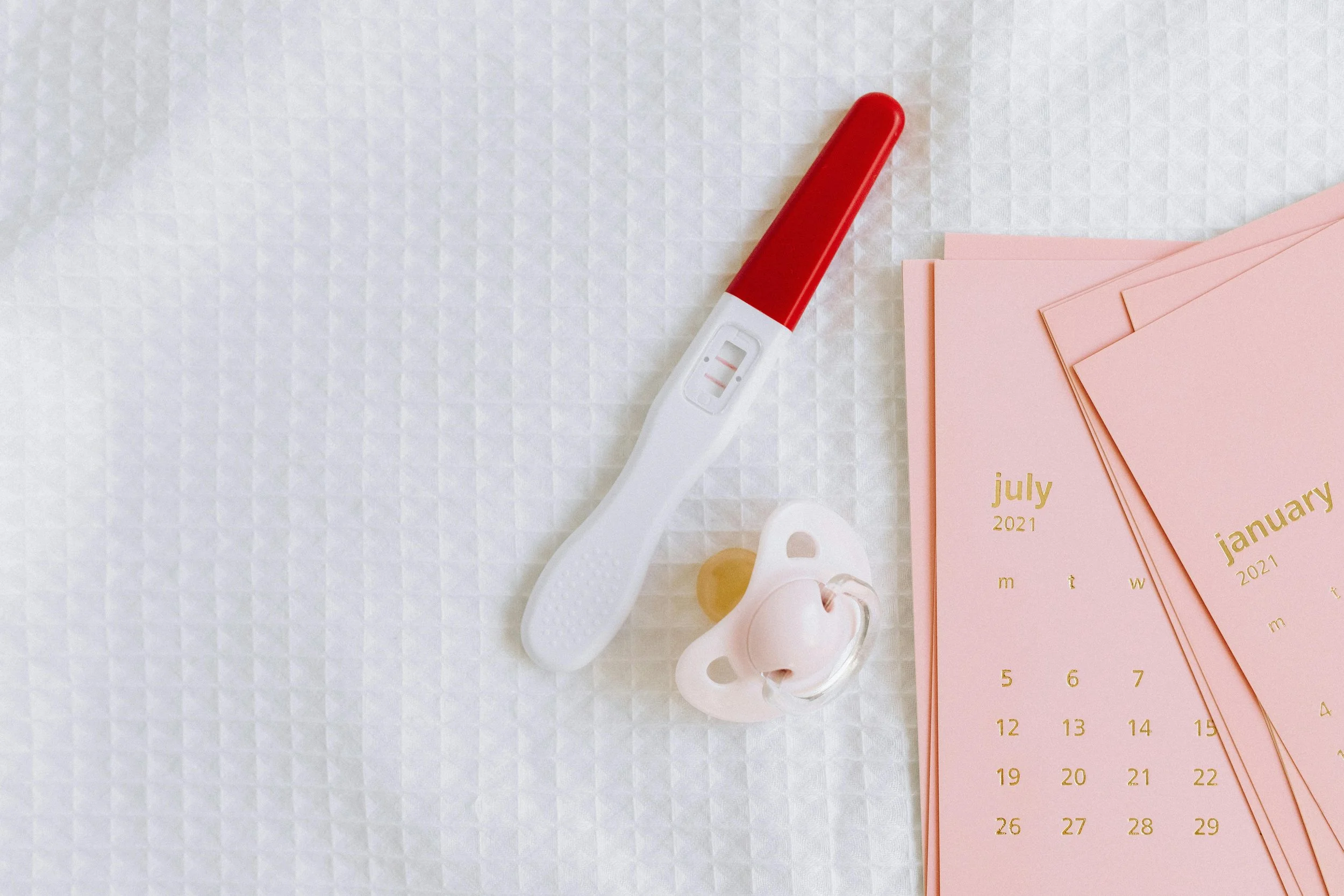
It’s actually wild when you think about it: we spend the first 10–15 years of our adult lives being told to be careful, warned that pregnancy could happen if you even looked at someone too long.
Fast-forward to when you’re finally ready, and suddenly it’s like a math puzzle written in invisible ink. There’s this tiny sliver of days where it’s even possible, and you’re left trying to decode your own body like it’s a riddle from a YA fantasy novel.
A little background on me: I’ve always had an irregular cycle — anywhere from 28 to 40+ days — so trying to predict ovulation felt like throwing darts in the dark. I don’t have PCOS, but for a long time I wondered if I might. And I’ve always had horrible, curl-into-a-ball cramps with pain so intense I’ve gotten close to vomiting. Endometriosis has always lived in the back of my mind as a possibility, but I was never formally evaluated or diagnosed. Basically: not the straightforward cycle you hope for when you start trying.
Preparing My Body
I have a nephew with a neural tube defect, and my sister has always stressed the importance of folic acid and taking a prenatal as soon as you’re even thinking about getting pregnant. So in the months leading up to trying, I started taking the Perelel Conception Support Pack and their Fertility+ Support. I don’t know if they were part of the magic, but it felt good to feel like I was doing everything I could to support my body.
I’ve Got Gadgets and Gizmos a-Plenty
I started out tracking with my Oura Ring through Natural Cycles and honestly, I loved the convenience of it. It synced my basal temperature automatically every morning without me having to think about it. The subscription is covered by insurance, and the app had great visuals, clear guidance, and was often accurate about when my period would start or stop — at least within a few days.
But “within a few days” isn’t accurate enough when you have an irregular cycle and you’re trying not to miss the narrowest window of opportunity known to woman. So I kept exploring what else was out there.
Next, I tried Kegg — a medical-grade fertility tracking device that measures cervical fluid to predict your fertile window. You insert it for two minutes each day to get a reading. In theory, super cool. In reality… a little chaotic for me.
The app was incredibly hard to understand. Nothing felt definitive, the charts were confusing, and trying to track “spikes” or “drops” was nearly impossible when the whole thing looked like a squiggly EKG. Even after messaging customer service, I still wasn’t getting the clarity I needed. And Kegg was giving me a completely different fertility window than Natural Cycles. None of it lined up, and none of it felt right (because it wasn’t).
After a couple months of no success, I was craving something more precise. And truly… bless this little device. It was the only one that gave me accurate, consistent readings.
It’s a very cool setup: you pee on a test strip, insert it into this little gadget that plugs into your phone, and within a couple minutes, it gives you a full hormonal readout. Inito measures LH, Estrogen, Progesterone, and FSH — so instead of vague trends or confusing squiggles, you get concrete, data-backed answers.
It told me exactly when I was ovulating, not just the general neighborhood of when it might be. And, of course, the ovulation window Inito gave me was completely different from both Natural Cycles’ and Kegg’s predictions.
We got pregnant on our first try using it, and honestly, I have no idea how many more months I would’ve spent missing the window with the other methods.
Testing 1-2-3
By the time 11 days post-ovulation rolled around, I wasn’t feeling super hopeful. In fact, I felt really PMS-y. My boobs hurt, I was crampy, moody — genuinely a 50/50 toss-up between “my period is coming” or “I’m pregnant.” Why are the symptoms the same?
Still, I just had this weird little gut feeling. So when I woke up in the middle of the night (or very early morning — who knows) to pee, I remembered that early-morning urine is best for testing and figured, while I’m up…I didn’t mean to take the test alone, I just couldn’t not.
When the result appeared, I stared at it for a few seconds. And then I did the only rational thing: sprinted into the bedroom, test in hand, iPhone flashlight blazing.
“Todd, wake up!”
He bolted upright thinking we were being robbed, raided, abducted by aliens — and I shoved the test in his face. He blinked a few times, realized what he was looking at, and then it was just hugging, crying, whispering “oh my god” a dozen times, and absolutely no going back to sleep.
And with all of this, I want to say: I know a lot of people walk much longer, harder, more complicated paths. It’s not lost on me. I carry that awareness with me — the gratitude, the humility, the softness for anyone whose story looks different. This is just mine — my little thread in the giant, tangled ball of how people become parents.
If any of the things I tried along the way — the gadgets, the trackers, the supplements, the “maybe this will help” experiments — happen to point someone else in a direction that brings them clarity, comfort, or even just a tiny bit of control in an uncontrollable process… then I’m glad I wrote it all down.
